

A granny flat is a significant investment — typically €70,000 to €120,000 — and for most Dublin homeowners, it’s a project they will only ever do once. That makes choosing the right builder one of the most important decisions in the entire process.
Unfortunately, the granny flat and modular home market in Dublin has grown quickly in recent years, and not every company offers the same level of transparency, quality, or accountability.
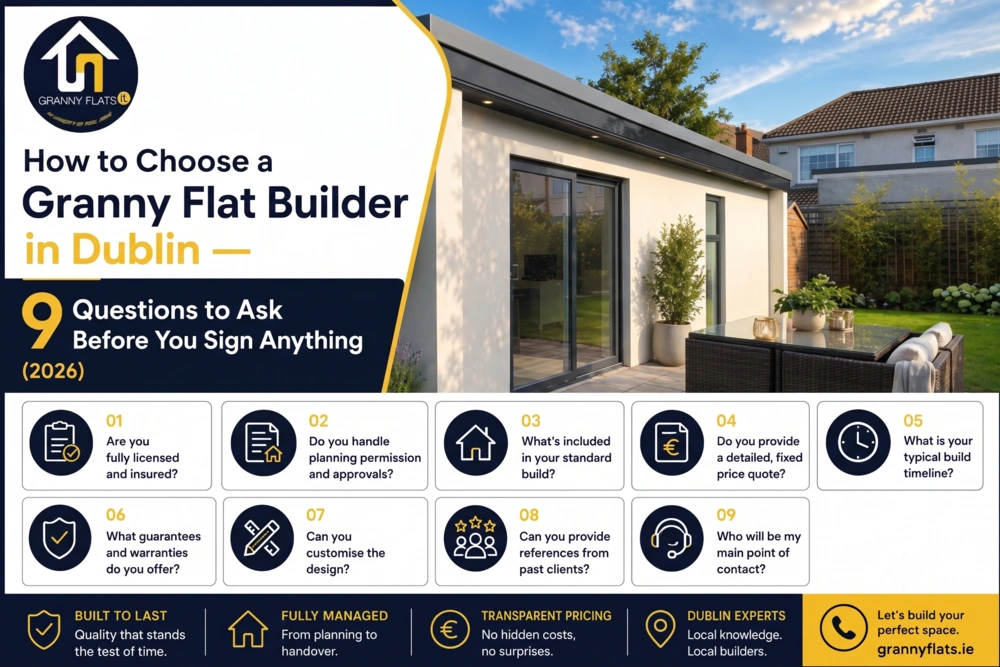
This guide gives you nine direct questions to ask any builder you’re considering — including us — so you can make a confident, informed decision.
1. “Is the Price You’re Quoting Genuinely Fixed?”
This is the single most important question in the entire process.
Many granny flat quotes in Dublin are advertised as starting prices — “from €69,000 + VAT” — but what’s actually included in that figure varies enormously between companies.
Some quotes cover only the basic shell, with kitchen, bathroom, flooring, electrics, and finishing all priced as extras. By the time these are added, the final cost can be 30–50% higher than the advertised figure.
What to ask
“If I sign at this price today, is this genuinely the final cost — including kitchen, bathroom, flooring, electrics, decoration, and connections — or are there items that will be quoted separately later?”
What a good answer sounds like
A reputable builder should be able to give you a single, all-inclusive figure and a written specification listing exactly what’s covered.
At GrannyFlats.ie, our published prices include design, planning support, groundworks, ICF construction, roofing, kitchen, bathroom, windows, flooring, decoration, plumbing, electrics, and carpentry — with no hidden extras.
2. “How Is the Flat Actually Constructed?”
There’s a meaningful difference between a granny flat built on-site to residential standards, and a modular or prefabricated unit delivered on a lorry and craned into position.
Both approaches have a place in the market — modular units can be faster to install — but they are not the same product, and the long-term performance, insulation quality, and durability can differ significantly.
What to ask
“Is this built on-site with concrete foundations, or is it a modular/prefabricated unit? What is the wall construction method?”
What a good answer sounds like
The builder should be able to explain their construction method clearly and confidently, including foundation type, wall construction (e.g. ICF — Insulated Concrete Formwork, timber frame, block, modular panels), and roofing system.
At GrannyFlats.ie, every flat is built on-site on proper concrete foundations using ICF construction — the same standard as a traditional home, not a temporary or lightweight solution.
3. “Who Handles Planning Permission — and What Happens If It’s Refused?”
Planning permission is one of the most significant risks in any granny flat project in Dublin.
If you sign a contract, pay a deposit, and then planning is refused, what happens to your money — and your plans?
What to ask
“Do you handle the entire planning application? What happens to my deposit if planning permission is refused?”
What a good answer sounds like
The builder should manage the full planning process — site assessment, drawings, application, and council liaison — as a core part of their service, not an optional extra.
They should also be upfront about the (generally low, but real) possibility of refusal and what that means contractually.
Ask for this in writing.
4. “Can I See Recently Completed Projects — and Speak to Those Clients?”
Photos on a website tell you very little.
What matters is whether a builder has a track record of completed, occupied granny flats in Dublin — and whether real clients are happy to vouch for the experience, not just the finished product.
What to ask
“Can I visit a recently completed project, or speak to a previous client about their experience — including how the project was managed, not just how it looks?”
What a good answer sounds like
A builder with a genuine track record should have no hesitation connecting you with past clients or showing you completed work.
Be cautious of any builder who can only show renders, mockups, or stock photography rather than real, completed Dublin projects.
5. “What’s the Realistic Timeline — Including Planning?”
Some companies quote build timelines only — “9 to 13 weeks” — without making clear that this is the construction phase alone, and doesn’t include the months required for planning permission beforehand.
What to ask
“From the day I sign, how long until I have keys — including planning permission, design, and construction?”
What a good answer sounds like
A realistic, honest answer for a Dublin granny flat requiring planning permission is typically 6 to 8 months total — roughly 3–4 months for planning (including preparation) and 9–13 weeks for construction.
Be wary of any builder promising significantly faster timelines that include planning permission, as this often signals an unrealistic picture being painted to win the sale.
6. “Who Will I Actually Be Dealing With During the Build?”
For a project of this size, communication matters enormously.
Will you have a single point of contact who knows your project intimately, or will you be passed between sales, design, planning, and site teams — each of whom may not know what the others have told you?
What to ask
“Will I have a single point of contact throughout the project, from design to handover?”
What a good answer sounds like
Smaller, owner-managed companies often genuinely offer this — you deal with the same person or small team throughout.
Larger companies may have more resources but can suffer from internal communication gaps.
Ask specifically how issues, changes, or questions get resolved during the build, and who is accountable.
7. “What Insurance and Guarantees Are in Place?”
A granny flat is a permanent structure on your property.
If something goes wrong — structurally, or with a tradesperson on-site — what protection do you have?
What to ask
“Are you fully insured for the construction work? What warranty or guarantee applies to the finished structure, and for how long?”
What a good answer sounds like
The builder should confirm they carry appropriate public liability and contractor’s insurance.
They should also explain what guarantee applies to structural elements, waterproofing, and fittings after handover — and for how long.
Get this in writing as part of the contract.
8. “What Happens After Handover If Something Needs Fixing?”
The real test of a builder isn’t how the project goes — it’s what happens if something needs attention six months after you’ve moved in.
What to ask
“If something needs fixing after handover — a tap, a door, a finish — who do I call, and what’s your typical response time?”
What a good answer sounds like
A builder confident in their work should have no hesitation committing to an aftercare process.
At GrannyFlats.ie, we stand over our work after handover — when the job is done, we’re still here.
9. “Can I See the Contract Before I Pay Any Deposit?”
This sounds obvious, but it’s worth stating directly.
You should be able to read the full contract — including payment schedule, specification, timeline, and what happens in various scenarios (planning refusal, delays, changes) — before paying any money.
What to ask
“Can I have a full written contract, including specification and payment schedule, to review before paying a deposit?”
What a good answer sounds like
Yes, without hesitation.
Any reluctance to provide a clear written contract before taking payment is a significant warning sign.
A Quick Checklist
Before signing with any granny flat builder in Dublin, make sure you can confidently answer “Yes” to these key questions:
- Is the quoted price genuinely all-inclusive?
- Has the construction method been clearly explained?
- Does the builder manage planning permission?
- Have you seen completed projects and spoken to previous clients?
- Has the full project timeline been explained honestly?
- Do you know who your main point of contact will be?
- Are insurance and guarantees confirmed in writing?
- Is aftercare clearly explained?
- Have you reviewed the full contract before paying a deposit?
If any of these is missing or unclear, it’s worth pausing before proceeding — regardless of which builder you’re considering.
About GrannyFlats.ie
We’re a small, family-run business — sisters Lee and Celine — specialising in granny flats across Dublin for over 10 years.
We’ve built our reputation on:
- Fixed pricing
- On-site construction to full residential standards
- Fully managed planning
- Direct, personal involvement in every project from first enquiry to handover
We’re happy to be asked every one of the questions above — and we’d encourage you to ask any builder you’re considering the same.
Book a Free Consultation
Book a free, no-obligation site consultation and judge for yourself.
Call: 01 615 5653
WhatsApp: 087 288 9127
Or get in touch through our website.
GrannyFlats.ie
7 The Mall, Main Street, Leixlip, Kildare
Serving Dublin and commuter areas for over 10 years.


