

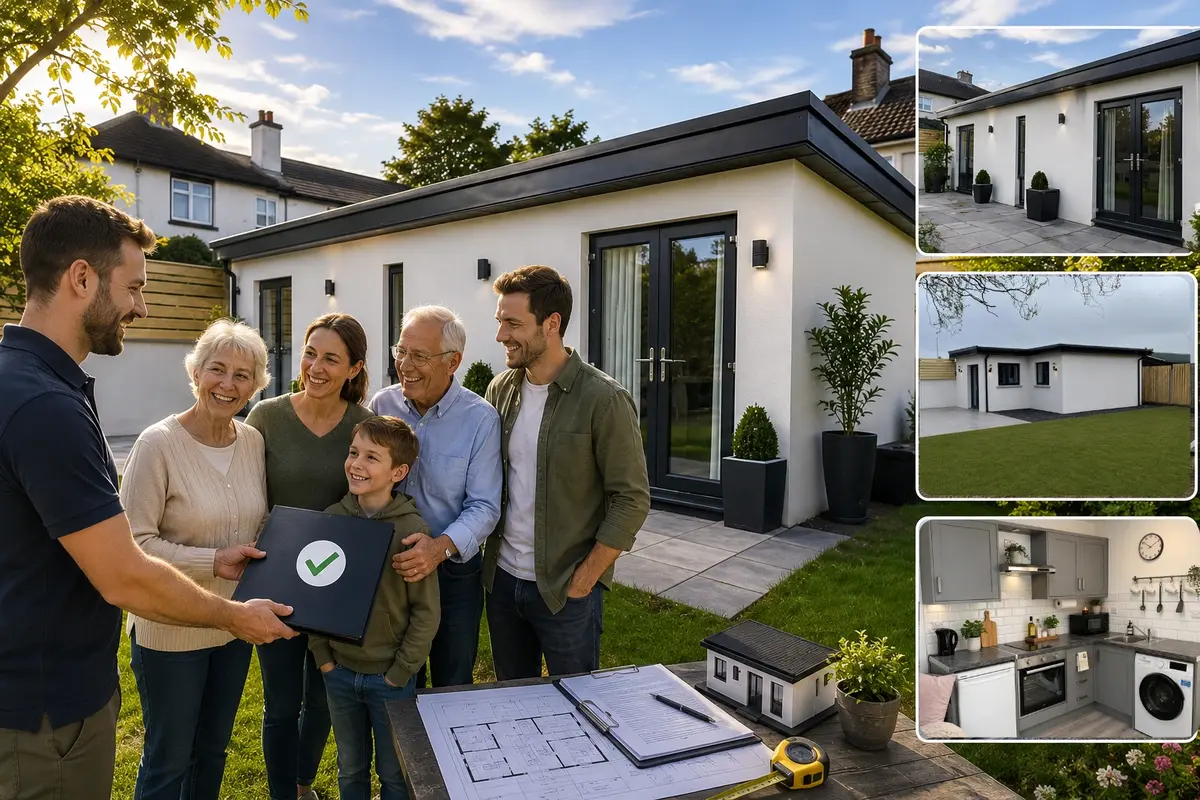
Planning Exempt Granny Flats Ireland (2026): New Rules Effective from 27 July
Everything You Need to Know
The Irish Government has introduced new planning exemption regulations that allow many homeowners to build a detached granny flat in their back garden without applying for full planning permission, provided the development complies with the exemption conditions and Building Regulations.
This is one of the biggest changes to Irish planning rules in decades and will make it much easier for families to create additional living space for parents, adult children, carers or other family members.
At GrannyFlats.ie, we can guide you through every step of the process—from design and compliance to construction and registration.
What Can Be Built?
Under the new exemption, an auxiliary habitable dwelling (commonly called a granny flat) can generally be built:
- Detached from the main house
- Between 32m² and 45m²
- As a fully habitable living space
- Connected to the services of the existing house (water, drainage and electricity)
- Without a full planning application, provided all exemption conditions are met.
Size Requirements
Minimum floor area: 32m²
Maximum floor area: 45m²
Anything larger than 45m² will normally require planning permission.
Height Restrictions
The proposed regulations include maximum building heights.
Typical limits include:
- Maximum height for a pitched roof: 4 metres
- The building must remain a single-storey structure.
Our design team ensures every design complies with these requirements.
Registration with Your Local Authority
Although planning permission may not be required, the dwelling must still be registered with your local authority in accordance with the new regulations.
We can assist with the required documentation and make the process as straightforward as possible.
Building Regulations Still Apply
Planning exemption does not mean Building Regulations can be ignored.
Every granny flat must comply with:
- Building Regulations
- Building Control Regulations
- Fire Safety requirements
- Structural standards
- Energy efficiency requirements
- Ventilation requirements
- Accessibility requirements where applicable.
Services
The granny flat must normally be connected to the existing home’s services, including:
- Water supply
- Wastewater drainage
- Electricity
These are not intended to be completely independent houses with separate utility infrastructure.
Who Is It For?
The new exemption is ideal for:
- Elderly parents
- Adult children
- Family members requiring independent living
- Live-in carers
- Multigenerational families
Every Property Is Different
Even with the new exemption, every site must still satisfy the conditions set out in the regulations.
Factors that may affect eligibility include:
- Available garden space
- Distance from boundaries
- Existing structures
- Site drainage
- Access
- Services
- Compliance with Building Regulations
Before any work starts, we’ll assess your property to confirm whether your project qualifies.
How We Can Help
At GrannyFlats.ie, we look after the entire process.
We can provide:
- ✔️ Free site consultation
- ✔️ Design and layout advice
- ✔️ Compliance checks
- ✔️ Registration guidance
- ✔️ Full turnkey construction
- ✔️ Fixed-price quotations
- ✔️ A concrete-built granny flat that’s built to the same standard as a permanent home
Free Site Assessment
Not sure if your garden qualifies?
Contact our team today and we’ll assess your property, explain the new regulations, and help you decide on the best granny flat for your family—with no obligation.
Important Note
While the Government has announced these new exemptions and they are due to take effect on 27 July 2026, the final statutory regulations and detailed technical conditions should always be checked before construction begins, as specific exemption criteria and registration requirements are set out in the legislation itself.

5 Comments
denis dolan
my detached garage is already bulit to housing standards with electricity and attached mains water swerage to main tank is not yet connected wat neeed i to do to finish off the granny flat for myself